Universidad Europea
International Relations Office
Would you like to study abroad?
If, since you began your Bachelor's Degree studies, you have wanted to study at another university somewhere else in the world, this is the place for you!
What is study abroad?
Study abroad allows you to study at a foreign university for one or two semesters without losing your academic progress. It can be done through the Erasmus+ programme (within the European Union) or through bilateral agreements (outside the European Union). In both cases, you will take courses that are recognised in your qualification at the European University of Madrid, while enjoying a unique academic and cultural experience.
Types of stays
Erasmus +
Stays at universities in the European Union and in countries outside the European Union participating in the Erasmus programme, with monthly financial support and academic recognition.
Bilateral Programmes
Exchange with universities outside the European Union: USA, China, Japan, Australia, Canada, etc.
Blended Intensive Programme (BIP)
Combined programme (online + short-term on-campus) to collaborate with students from other European universities on international challenges. They include financial support for the stay (1 week) and academic recognition of up to 3 ECTS.
Summer Years
If you are studying for a Bachelor's Degree in Medicine, you have the opportunity to enjoy training during the months of June and July at one of these destinations: Yale University (US), University of Liverpool (UK), or Wisley Hospital (Australia).
In addition, there is the possibility of taking summer years at the University of the Arts London for students studying design (all specialities), video games and animation at the creative campus.
Mobility for Master's and Higher Vocational Training students (CFGS)
If you are a student of an official two-year Master's degree, you can apply for all mobility modes listed in this guide, including Erasmus+ studies or traineeships within Europe, provided you meet the required academic and credit criteria.
In the case of one-year Master's degrees, study mobility is not feasible; however, you may opt for Erasmus+ traineeships. This allows you to carry out your professional internship in another European country under the Erasmus+ program framework (mobility period from 2 to 12 months).
If you are enrolled in Higher Vocational Training (CFGS), you can apply for a grant to complete your professional internships abroad with Erasmus+ Vocational Education and Training (VET) funds. This will allow you to develop practical skills at a company or institution in another participating country.
In both cases, we recommend checking the Student Portal, under the Calls and Listings section, where current calls, deadlines, and specific requirements for each type of mobility are published.

What are OLA, the MoveOn platform and the Study Agreement?
Familiarise yourself with the key words and concepts to understand everything about the international experience.
We have prepared this "mobility dictionary" for you.
Your Mobility dictionary
EU Learning Agreement and ACUE Platform | A document that all students must complete, indicating the courses they will study at their destination and the courses that will be validated at the European University. This document requires validation by the International Relations Office in order to be finalised. To prepare your study agreement, you must log in to the ACUE platform and complete it with your proposal. You will receive an email to access the platform with your UEM passwords. |
CAP | Personal Academic Certificate. Request for academic transcripts for some destinations through the Student Portal. These contain the grades obtained in all courses completed up to the time of requesting the certificate. No averages are shown, only the grade/grade in each course. You must request your CAP in the language required by the destination university (English or Spanish). |
Certificate of arrival | Document in which the host university confirms that the student has begun their Erasmus+ stay. It must be signed by the host university upon your arrival and sent via MoveOn. |
Certificate of Grades - TOR - Transcript of records | Certificate of grades. Document certifying the grades/marks obtained in the courses taken during the student's study abroad. |
Certificate of departure | Document certifying the end of the Erasmus+ stay. It must be signed by the host university upon your departure and sent via MoveOn. |
Grant agreement | Document containing the details of the stay and bank details in order to manage the scholarship linked to your Erasmus+ mobility. It must be sent via MoveOn. |
Grant agreement for disadvantaged students | Grant agreement for less-advantaged profiles attached to the list of Erasmus+ grants on the Portal. It must be sent via MoveOn. |
International Coordinator | This is your contact person at the International Relations Office who will guide and advise you throughout the academic and administrative process. Find out who yours is in the Outgoing Student Guide. |
European Commission satisfaction survey (EU Survey) | Survey automatically sent from the European Commission's Beneficiary Module platform to students completing Erasmus+. You must complete this survey in order to receive your financial aid. |
Outgoing student | A student who has been selected to study at another university abroad as part of an exchange programme. |
Outgoing student guide | Comprehensive manual with all the information you need to know. |
List of admitted students | This is the document through which the list of students is communicated who, having met all the requirements to participate in a call for entries, have been admitted to apply for one of the available places. This list may be provisional, in which case any errors can be corrected, or definitive, once such errors have been corrected. |
List of place allocations | This is the document that announces the destinations assigned to each student, according to their qualification and average grade in their academic record. This list is provisional in the first instance, allowing students to make representations, or final. |
MoveOn | This is the mobility management platform used by the European University, where you will have to complete some of the steps in the process (you already used it to apply for your place). |
Destination map | Map showing the universities with which the European University has mobility agreements for qualifications. |
Online learning agreement (OLA) | Erasmus+ online document with courses already validated in the Study Agreement. It is signed by the two universities: destination and origin + student on the MoveOn platform. It must also be completed in order to receive your financial aid. |
Academic offer | This is the set/list of years, courses or modules that the destination university offers to incoming exchange students. It should be noted that this often differs from the academic offering available to regular students, so it is necessary to ensure that you have the correct information. |
Application Process | This is the process you must follow to formalise your application at the host university we have granted you, in which the host university will request specific documentation from you. |
European Health Insurance Card (EHIC) | A free card that covers healthcare during an Erasmus+ stay. |
How can I apply for study abroad?
The first thing you should know is that you must apply for a semester/year-long stay during the academic year prior to the one in which you wish to participate in the mobility programme. Keep this in mind so that you can plan ahead.
The process begins with your participation in International Week, which we hold every year in October and which we will announce at the beginning of October through all available media.
Below is a summary of the process you will go through over the course of a year from the moment you apply for the stay, which we have divided into two stages: the application and the preparation for your stay.
Application
1. Carefully read the International Mobility Call for Entries published by the International Relations Office (ORI). This is usually announced at the end of October by email, on campus screens, on the Student Portal and on the ORI Instagram account.
2. Study all the available destinations carefully and... fill in your application! You can fill in an application for a stay with up to three destinations, in order of preference.
3. Wait. Yes, now you just have to wait. Once you have filled in your application, we will spend the following weeks evaluating your applications. Destinations will be assigned according to your average grade in order to reward academic excellence.
4. Accept or reject our proposal. ORI will assign you a destination from among the three you have chosen. We may change the semester or duration of your stay if necessary.
Canarias
If you have reached this point and accepted your destination, it is time to prepare for your stay.
Preparing for your stay
The journey does not begin on the day you leave for your destination university, it began on the day you submitted your mobility application. Preparing for the trip is the stage that requires the most responsibility and leadership on your part. You must be aware of the challenges and key dates for each stage so that you can finally pack your bags and fly to your destination.
Check here to see what you need to do at each stage:
|
BEFORE |
|
▪ Attend the ORI information sessions. You will receive the information by email. ▪ The ORI will nominate you to your destination university to let them know that you want to do a study abroad there (March for S1 stays and September for S2 stays). ▪ The destination university will contact you to complete certain documentation and formalise your application. ▪ Take a language test if your destination requires it. ▪ Keep an eye out for your acceptance letter from your destination university. ▪ Apply for health insurance (if you are on an Erasmus exchange, the European Health Insurance Card (EHIC) is sufficient). ▪ If you need a visa, apply for one at the consulate or embassy of your destination country in Spain. ▪ Find accommodation at your destination and book your flight or train. ▪ Complete the Study Agreement on the ACUE platform, which must be approved by your International Coordinator before 1 July (S1) or 1 December (S2). ▪ If you are an Erasmus student, fill in the OLA and Grant Agreement on the MoveON platform. |
|
DURING |
|
▪ Sign the certificate of arrival and attach it to MoveOn (Erasmus students only). ▪ Do you need to modify the Study Agreement? Send a new proposal to your international coordinator via the ACUE platform. ▪ We look forward to seeing you at the "Café Viajero" session. ▪ Sign the departure certificate and attach it to MoveOn (Erasmus students only)
|
|
AFTER |
|
▪ Send your Transcript of Records (TOR) so that your grades can be added to your UEM file. ▪ Complete the UEM Satisfaction Survey, which will be sent to you by email. Your opinion helps us to improve. ▪ If you have participated in Erasmus mobility, you must complete the European survey that will be automatically sent to your email address by the European Commission. ▪ Would you like to be a buddy to help other students who are planning their stay? Contact your International Coordinator ▪ Leave your testimonial about your stay on MoveON
|
What platforms should I use to manage my study abroad?
During the preparation process for your stay, you will use two platforms to help you manage the documentation you need to process.
- ACUE platform: this is the platform for drawing up and approving your Study Agreement, and you will need to use it whenever your stay is for a semester or a year, regardless of the destination. You will receive an email with access to the platform, and we will explain how it works during one of the ORI information sessions. On the platform, you will draw up your proposed study agreement and receive feedback from your international coordinator so that it can be approved in a timely manner. This is an essential requirement for your stay.
- MoveON platform: this is the platform you used to submit your application at the beginning of the process, as it is the platform through which we manage all mobility processes at the UEM. If your stay is Erasmus, whether it is a semester/year-long stay or a BIP programme, you will need to upload all the documentation to this platform in order to receive your financial aid. In addition, you must also upload your study agreement, already approved by your international coordinator, here. Please note that in the case of Erasmus stays, the study agreement is called an OLA (Online Learning Agreement). This is the link to MoveOn: MoveON .
Consultation of previous Study Agreements
Would you like to know which courses have been recognised in previous mobility programmes?
In this space, you can consult examples of study agreements passed for students from previous years. This information will give you an idea of the possible correspondence between courses and credits between your qualification and the host universities.
Important:
The agreements published here are of purely informational type. The study agreements available correspond to previous academic years and should not be interpreted as a guarantee of recognition or approval of courses in future mobility programmes. Each study agreement must be reviewed and formally approved by the International Relations Office (ORI), in accordance with current academic and institutional regulations.
Our international team is here to help you.
The Office of International Relations (ORI) will accompany you throughout this process to ensure that your study abroad is a success. Below, we introduce you to the team that will manage your mobility:
The International Coordinators will accompany you before, during and after your study abroad. They will be your point of contact for administrative issues related to mobility: information prior to the application process, the application process itself, nomination, submission of documentation, as well as guidance on academic aspects related to your stay; possible destinations, allocation of places, preparation of the Study Agreement, etc.
Check here to find out who your International Coordinator is, depending on the year of your Bachelor's Degree.




Valeria Sentina
European University of Madrid
School of Architecture, Engineering, Science and Computing (STEAM), Faculty of Design and Creative Technologies, and the fields of Communication and Education.
Raquel Mendiola
European University of Madrid
Faculty of Economics, Business and Communication and Faculty of Law, Education and Humanities. (except for the fields of Communication and Education).
Rocío Lorca
European University of Madrid
Faculty of Biomedical and Health Sciences and Faculty of Medicine, Health and Sports
European University of the Canary Islands
Faculty of Social Sciences, Faculty of Health Sciences and School of Architecture
STUDENT VOICES
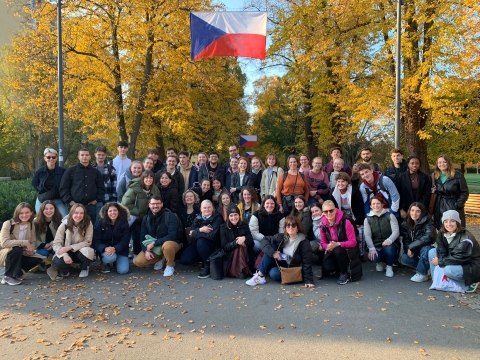


Sofía Chen - Bachelor's Degree in Psychology - University of Hertfordshire
Ricardo Fernández Camblor - Bachelor's Degree in CAFYD - Università degli Studi di Torino
Rebeca Serrano - Bachelor's Degree in CAFYD - Lunex University
Mario Ortega – Bachelor's Degree in Medicine - Warszawski Uniwersytet Medyczny
Hugo Cochard - Bachelor's Degree in Sports Management - Appalachian State University
Agustina Berra - Global Bachelor's Degree in Sports Management - University of New Haven
FAQs
Why does the process start almost a year before I leave?
The destination universities need all your details at least 6 months before the start of your stay. In addition, a lot of paperwork, such as visas, or procedures, such as finding accommodation, require several months of processing
Where can I find out about the available destinations?
You can find all the information on the destination map published on the website: Map. In the case of BIP programmes or Erasmus+ internships, you will need to keep an eye out for the calls for entries that we publish throughout the academic year on the student portal.
Is it compulsory to attend the three information sessions offered by the International Relations Office?
Yes, once you have accepted your place and started to prepare for your trip, it is essential to attend the information sessions offered by the ORI, each of which will cover a topic that is important for your stay.
What documents will I need for my mobility?
International health insurance, which in the case of Erasmus can be the European Health Insurance Card (EHIC), the study agreement (a document confirming the courses you will be taking during your stay and, if you pass, they will be approved on your return), the arrival and departure certificates at your destination, and the grant agreement and European Satisfaction Survey if your mobility is Erasmus. In addition, depending on your destination, a valid visa or NIE.
Do I need to do anything with the host university?
Yes, once the destination university contacts you, you must complete the application process with them (send the documentation they request, your transcript, language certificate if required, and pay tuition for courses at your destination).
Who draws up the study agreement and when?
It is your responsibility to complete the Study Agreement, which is an essential requirement for your subjects to be recognised in your EU academic record. You must complete it on the ACUE Platform, access to which you will receive by email. Your International Coordinator will guide you through the process.
Is there a minimum or maximum number of courses to be recognised after my stay?
There is no minimum number of courses to be recognised at your destination, although the maximum is 30 ECTS per semester, which is the recommended number.
How many changes can be made to the Study Agreement?
Once the Agreement has been validated and signed, you can only make two modifications on this platform, always informing your International Coordinator. If you are on an Erasmus stay, whenever you modify the study agreement, you will have to change it in the OLA – Online Learning Agreement, which you must upload to the MOveON platform.
Can I do my final year project, or even include it in the Study Agreement for recognised, during my study abroad?
The final year project cannot be recognised in the Study Agreement and the defence must always be carried out in accordance with the provisions of the TFG Learning Guide.
How do I find accommodation at my destination?
The host university will provide you with information on possible accommodation. We recommend that you start looking at least three months before your stay, but do not confirm or pay for anything until you have signed your study agreement.
Will I receive any financial aid or scholarship during my mobility?
Yes, as long as your mobility is Erasmus or you have obtained one of the Santander Mobility Grants. The amount will be published as an annex to the mobility call for entries at least two months before the stay, when the national agency SEPIE confirms the funds.
When will I receive my scholarship payment?
70% of the total scholarship amount will be paid upon arrival at your destination and submission of all Erasmus documents, and 30% will be paid upon your return and completion of the end-of-stay documents. In the case of Santander grants, the amount will be received once you are at your destination.
What courses should I enrol in at the UE during my stay?
You must Enrol in all the courses that appear in the Study Agreement at the European University. This way, upon your return, once you have passed the corresponding courses at your destination, we will be able to recognise these courses in your academic transcript.
When will I receive confirmation that my study abroad will take place?
Once your place has been assigned and accepted by you, we will send your information to the destination university. Your stay will be guaranteed when the destination university reviews your application and confirms that you have been accepted.
When I review my enrolment at the European University, I see that the subjects I am enrolled in at the destination university do not have an associated group. Is that correct?
Yes. This is how it should be in principle, so that you are not assessed by the subject lecturer at the European University.
What should I do if I encounter a problem while I am there?
Contact your International Coordinator immediately.
Can I request to extend my semester stay while I am at my destination?
With some exceptions, all mobility programmes are semester-long. If, once you arrive at your destination, all of the following conditions are met, an extension may be considered: there must be places available under the agreement, a scholarship must be available in the case of Erasmus destinations, and the courses must be recognised as valid for another 30 ECTS credits.
When will I see my credits recognised in my academic record?
At the end of your stay, the host university will send you your transcript of records (TOR), which you must share with your international coordinator at UEM so that they can process the recognition in your academic record.
What criteria will be used to convert foreign grades when assessing courses at the European University?
For the conversion of foreign university grades to the Spanish system, the European University's international grade conversion tables published in the Outgoing Student Guide will be applied.
What happens if I fail a course during my stay? Am I entitled to an Extraordinary exam period at the European University?
Like any other student, you have two calls for entries for each course. If you take both at your destination, you will no longer be entitled to the European University's Extraordinary exam period in July for the equivalent subject. However, if you only use one call for entries at your destination, you are entitled to take the European University's Extraordinary exam period in July on the dates established for the equivalent subject in your Study Agreement. To do so, you will need to submit a request on the Student Portal to your academic advisor, who will assign you to a group for the course so that you can access the Contents and the professor can evaluate you.
Can I cancel my study abroad at any time?
You can cancel the place we have awarded you before the start of the mobility programme. Please note that cancelling without a valid reason means that the average mark you will compete with the next time you apply will be 5.
Can I do Erasmus+ studies and internships at the same time?
No. You cannot participate in two Erasmus programmes at the same time. If you want to consider an Erasmus internship, you can use your stay to look for a company, but you cannot start the internship until you have completed your study mobility. If you want to apply for this type of mobility, you must apply for a place in the Erasmus Internship Mobility call for entries. For more information, contact [email protected]
Outgoing Student Guide
This document contains all the information you need about the mobility process, which you can consult at any time during the process.
Here you will find short videos on how to access and use the ACUE and MoveON platforms, as well as the Destination Map.
ACUE PLATFORM
DESTINATION'S MAP
ERASMUS+ DOCUMENTS
ONLINE LEARNING AGREEMENT (OLA)

Questions?
You can reach us at:
Madrid: [email protected]
Canarias: [email protected]
We'll be happy to support you throughout your international journey.